Wooey 是一个简单的 Web 界面,用于运行命令行 Python 脚本。您可以把它想象成一种轻松将脚本部署到 Web 上,用于日常数据分析、文件处理或其他任何用途的方法。
Wooey 的设计初衷是为数据分析师提供一个能够轻松执行以下操作的系统:
1. Autodocument workflows for data analysis
    (simple model saving).
2. Enable fellow co-workers with no command line
    experience to utilize python scripts.
3. Enable the easy wrapping of any program in simple
   python instead of having to use language specific
   to existing tools such as Galaxy.
Django page CMS is based around a placeholders concept. Placeholder is a special template tag that you use in your page templates. Every time you add a placeholder in your template such field dynamically appears in the page admin interface.
Each page can have a different template with different placeholders.
A configurable set of panels that display various debug information about the current request/response.
Django Debug Toolbar
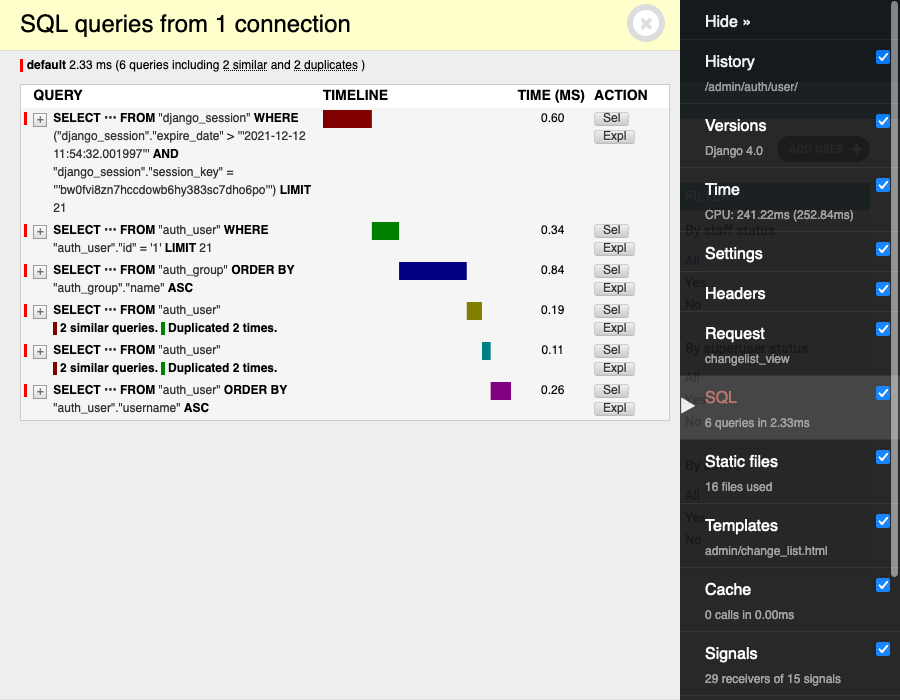
The Django Debug Toolbar is a configurable set of panels that display various debug information about the current request/response and when clicked, display more details about the panel's content.
Here's a screenshot of the toolbar in action:
In addition to the built-in panels, a number of third-party panels are contributed by the community.
The current stable version of the Debug Toolbar is 5.2.0. It works on Django ≥ 4.2.0.
The Debug Toolbar has experimental support for Django's asynchronous views. Please note that the Debug Toolbar still lacks the capability for handling concurrent requests If you find any issues, please report them on the issue tracker.
django-devserver has some optional dependancies, which we highly recommend installing.
pip install sqlparse -- pretty SQL formatting
pip install werkzeug -- interactive debugger
pip install guppy -- tracks memory usage (required for MemoryUseModule)
pip install line_profiler -- does line-by-line profiling (required for LineProfilerModule)
You will need to include devserver in your INSTALLED_APPS:
INSTALLED_APPS = (
    ...
    'devserver',
)
If you're using django.contrib.staticfiles or any other apps with management command runserver, make sure to put devserverabove any of them (or below for Django<1.7). Otherwise …
django-debug-toolbar in WebKit DevTools. Works fine with background Ajax requests and non-HTML responses.
Django Debug Panel
Django Debug Toolbar inside WebKit DevTools. Works fine with background AJAX requests and non-HTML responses Great for single-page applications and other AJAX intensive web applications.
(Optional) Configure your cache All the debug data of a request are stored into the cache backend debug-panel if available. Otherwise, the default backend is used, and finally if no caches are defined it will fallback to a local memory cache. You might want to configure the debug-panel cache in your settings:
A django-debug-toolbar panel that displays template rendering times for your Django application
Template-Timings
Template-timings is a panel for Django Debug Toolbar that gives an in-dept breakdown of the time it takes to render your Django templates (including templates included via {% extends %} and {% include %}).
Template-timings supports Django 1.11 and below, Django 2.0 and above do not work at the moment.
Install
Install via pip (pip install django-debug-toolbar-template-timings) then add 'template_timings_panel.panels.TemplateTimings.TemplateTimings' to your DEBUG_TOOLBAR_PANELS setting, and add 'template_timings_panel' to your INSTALLED_APPS:
In my experience this panel adds about 10% overhead. The panel uses the standard SQLPanel that ships with debug-toolbar to handle the SQL timings, so if you disable that the overhead will decrease and you can still see the render times.
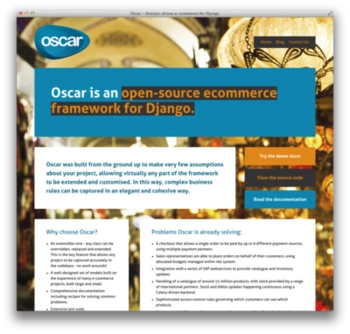
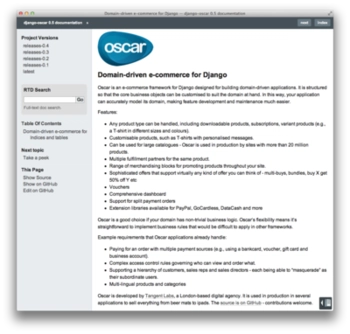
Oscar is an e-commerce framework for Django designed for building domain-driven sites. It is structured such that any part of the core functionality can be customised to suit the needs of your project. This allows a wide range of e-commerce requirements to be handled, from large-scale B2C sites to complex B2B sites rich in domain-specific business logic.
Build the database model out of the product's properties – not vice versa
Most e-commerce systems are shipped with a predefined database model for products. But products can vary a lot, and it simply is impossible to create a model which fits for all of them. This is esspecially true for products with a hierarchy of variants. In many popular e-commerce platforms you either have far too many attributes per product, and/or the really required attributes are missing.
In django-SHOP implementations, the product models reflect their pysical properties making it possible to create complete and deep hierarchies of variations, but without having to fiddle with unneeded properties. It furthermore avoids the need for an Entity Attribute Value Model, which is considered a database…
Shuup is International Registered Trademark & Property of Shuup Commerce Inc., Business ID: BC1126729, Business Address: 1500 West Georgia Suite 1300, Vancouver, BC, V6G-2Z6, Canada.
CLA
Contributor License Agreement is required for any contribution to this project. Agreement is signed as a part of pull request process. See the CLA.rst file distributed with Shuup.
License
Shuup is published under Open Software License version 3.0 (OSL-3.0). See the LICENSE file distributed with Shuup.
Some external libraries and contributions bundled with Shuup may be published under other compatible licenses. For these, please refer to VENDOR-LICENSES.md file in the source code tree or the licenses included within each package.
Chat
We have a Gitter chat room for Shuup. Come chat with us!
We're going to take you step-by-step to build a modern, fully open-source, eCommerce web application using Python, Django, Bootstrap, Javascript, and more.
eCommerce
This course will teach you step-by-step to build a eCommerce site from scratch. We'll be using open-source software to create each aspect of a fully functioning eCommerce business.
learn how to build, test and deploy a Django application
Course Introduction
The Django E-commerce Tutorial Series is designed for students who wants to learn the Django Framework by building an e-commerce application. This course is a great way to start learning Python and the Django Framework. We start from a beginners level slowly moving into more advanced topics. I have tried to design this course to be modular so that you could also focus in on particular subjects, tutorials or aspects of Django should…
Have a look at the sandbox site as this is a sample Oscar project integrated with both PayPal options. See the contributing guide within the docs for instructions on how to set up the sandbox locally.
The best way to have DRY Django forms. The app provides a tag and filter that lets you quickly render forms in a div format while providing an enormous amount of capability to configure and control the rendered HTML.
django-crispy-forms
The best way to have Django DRY forms. Build programmatic reusable layouts out of components, having full control of the rendered HTML without writing HTML in templates. All this without breaking the standard way of doing things in Django, so it plays nice with any other form application.
django-crispy-forms supports Django 4.2+ with Python 3.8+.
A filter named |crispy that will render elegant div based forms. Think of it as the built-in methods: as_table, as_ul and as_p. You cannot tune up the output, but it is easy to start using it.
A tag named {% crispy %} that will render a form based on your configuration and specific layout setup. This gives you amazing power without much hassle, helping you save tons of time.
Django-crispy-forms supports several frontend frameworks, such as Twitter Bootstrap…
The goal of this project is to seamlessly blend Django and Bootstrap 3.
Maintenance Mode
Bootstrap 3 has been superseded by Bootstrap 4, which has since been superseded by Bootstrap 5. As a result, this package is now in maintenance mode and will only receive bug fixes and security updates. No new features or enhancements will be added. We recommend that new projects use Bootstrap 5 and encourage existing projects to consider migrating when feasible.
For Bootstrap 4, please refer to our dedicated package: django-bootstrap4.
For Bootstrap 5, please refer to our dedicated package: django-bootstrap5.
For icons, we recommend our dedicated package: django-icons.
Requirements
This package requires a combination of Python and Django that is currently supported.
This package allows you to quickly filter or group "chained" models by adding a custom foreign key or many to many field to your models. This will use an AJAX query to load only the applicable chained objects.
Works with Django version 3.2 to 5.0.
Warning: The AJAX endpoint enforces no permissions by default. This means that any model with a chained field will be world readable. If you would like more control over this permission, the django-autocomplete-light package is a great, high-quality package that enables the same functionality with permission checks.
Documentation
For more information on installation and configuration see the documentation at:
The goal of this project is to seamlessly blend Django and Bootstrap 4.
Maintenance Mode
Bootstrap 4 has been superseded by Bootstrap 5. As a result, this package is now in maintenance mode and will only receive bug fixes and security updates. No new features or enhancements will be added. We recommend that new projects use Bootstrap 5 and encourage existing projects to consider migrating when feasible.
For Bootstrap 5, please refer to our dedicated package: django-bootstrap5.
Requirements
This package requires a combination of Python and Django that is currently supported.
This repository includes Dockerfile and docker-compose.yml files so you can easily setup and start to experiment with django-bootstrap-modal-forms running inside of a container on your local machine. Any changes you…
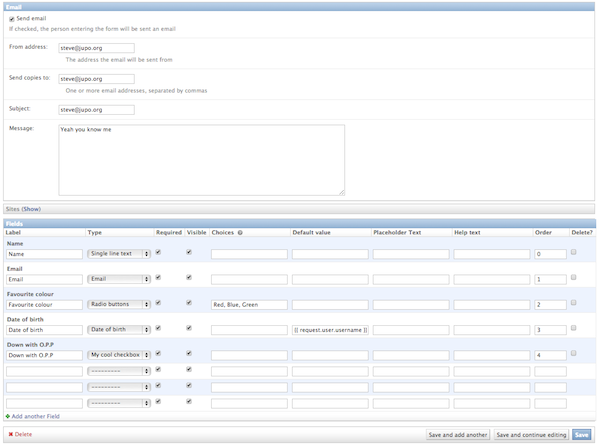
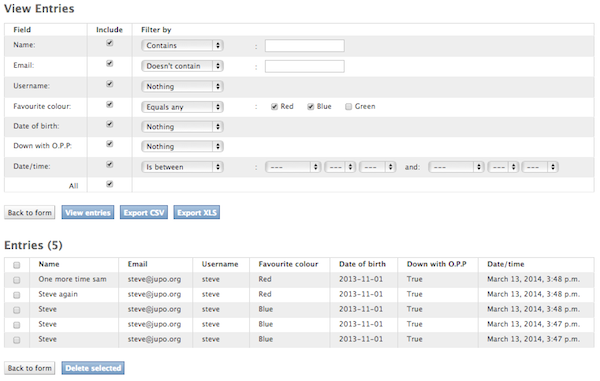
A Django reusable app providing the ability for admin users to create their own forms within the admin interface, drawing from a range of field widgets such as regular text fields, drop-down lists and file uploads. Options are also provided for controlling who gets sent email notifications when a form is submitted. All form entries are made available in the admin via filterable reporting with CSV/XLS export.
Form builder:
Data reporting:
HTML5 Features
The following HTML5 form features are supported.
placeholder attributes
required attributes
email fields
date fields
datetime fields
number fields
url fields
Installation
The easiest way to install django-forms-builder is directly from PyPi using pip by running the command below:
$ pip install -U django-forms-builder
Otherwise you can download django-forms-builder and install it directly from source:
$ python setup.py install
Once installed you can configure your project to use django-forms-builder with the following…
Django's "formtools" is a set of high-level abstractions for Django forms Currently for form previews and multi-step forms.
This code used to live in Django proper -- in django.contrib.formtools -- but was separated into a standalone package in Django 1.8 to keep the framework's core clean.
A package that allows you to serialize django forms, including fields and widgets into Python dictionary for easy conversion into JSON and expose over API
Please go through my djangocon US 2012 talk to understand the problem sphere, motivations, challenges and implementation of Remote Forms
Sample Implementation
If you don't mind digging around a little bit to learn about different the components that might be necessary for an implementation of django-remote-forms, check out django Remote Admin django-remote-admin
Mongodbforms supports all the fields that have a simple representation in Django's formfields (IntField, TextField, etc). In addition it also supports ListFields and MapFields.
File fields
Mongodbforms handles file uploads just like the normal Django forms. Uploaded files are stored in GridFS using the mongoengine fields. Because GridFS has no directories and stores files in a flat space an uploaded file whose name already exists gets a unique filename with the form <filename>_<unique_number>.<extension>.
Container fields
For container fields like ListFields and MapFields a very simple widget is used. The widget renders the container content in the appropriate field plus one empty field. This is mainly done to not introduce any Javascript dependencies, the backend code will happily handle any kind of dynamic form, as long…
GeoDjango provides geospatial extensions to the Django web dev framework
Django is a high-level Python Web framework that encourages rapid development
and clean, pragmatic design
All documentation is in the "docs" directory and online at
http://www.djangoproject.com/documentation/.  If you're just getting started
here's how we recommend you read the docs
    * First, read docs/install.txt for instructions on installing Django.

    * Next, work through the tutorials in order (docs/tutorial01.txt,
      docs/tutorial02.txt, etc.).

    * If you want to set up an actual deployment server, read docs/modpython.txt
      for instructions on running Django under mod_python.

    * The rest of the documentation is of the reference-manual variety.
      Read it -- and the FAQ -- as you run into problems.

Docs are updated rigorously. If you find any problems in the docs, or think they
should be clarified in any way, please take 30 seconds to fill out a ticket
here:

http://code.djangoproject.com/newticket

To get more help:

    * Join the #django channel on irc.freenode.net. Lots of helpful people
IP Address Location | IP Lookup | IP Geolocation API
The ipapi Python library provides convenient access to the IP address location service from applications written in the Python language. It makes it easy to harness the potential of the IP geolocation API.
This setting determines which day of the week your calendar begins on if your locale doesn’t already set it. Default is 0, which is Sunday.
OCCURRENCE_CANCEL_REDIRECT
This setting controls the behavior of :func:`Views.get_next_url`. If set, all calendar modifications will redirect here (unless there is a `next` set in the…
-----
About
-----
**django-future** is a Django application for scheduling jobs on specified
times
**django-future** allows you to schedule invocation of callables at a given
time.  The job queue is stored in the database and can be managed through the
admin interface.  Queued jobs are run by invoking an external django management
command
-----
Usage
-----

You need to have **django-future** installed. A recent version should be
available from PyPI.

To schedule jobs from your code, use the ``schedule_job`` function::

    >>> from django_future import schedule_job
    >>> import datetime

    >>> schedule_job(datetime.datetime(2010, 10, 10),
    ...              'myproject.myapp.handlers.dosomething')

------------
Running jobs
------------

Scheduled jobs will not start automagically.  The job queue must regularly
be processed by invoking the Django management command
``runscheduledjobs``.  You will probably want to run this command regularly,
perhaps in a cron job, to ensure that scheduled jobs are run in a timely
manner.

When the job processor is started, it
Make sure you have Django-RQ up and running before you do anything This app is just a simple admin plugin to manage your scheduled tasks and management commands.
Install the package with pip install django-rq-jobs
Add django_rq_jobs to INSTALLED_APPS in settings.py:
INSTALLED_APPS= (
# other apps"django_rq",
"django_rq_jobs",
)
Add RQ_JOBS_MODULE in settings.py. A string or a tuple of strings designating all modules where you keep your jobs. Anything marked with the Django RQ's @job decorator will show up in the admin.
# A singe module:RQ_JOBS_MODULE='myapp.tasks'# or with multiple modules:RQ_JOBS_MODULE= (
'myapp.tasks',
'anotherapp.tasks',
)
Run python manage.py migrate to create the job model.
Open your Django admin and find the RQ Jobs scheduled job section and schedule something.
Generate generic activity streams from the actions on your site. Users can follow any actors' activities for personalized streams.
Django Activity Stream
What is Django Activity Stream?
Django Activity Stream is a way of creating activities generated by the actions on your site.
It is designed for generating and displaying streams of interesting actions and can handle following and unfollowing of different activity sources. For example, it could be used to emulate the Github dashboard in which a user sees changes to projects they are watching and the actions of users they are following.
Action events are categorized by four main components.
Actor. The object that performed the activity.
Verb. The verb phrase that identifies the action of the activity.
Action Object. (Optional) The object linked to the action itself.
Target. (Optional) The object to which the activity was performed.
Actor, Action Object and Target are GenericForeignKeys to any arbitrary Django object and so can represent any Django model in your project An action…
An app for creating news feeds (also known as activity streams) for users, notifying them of activity happening around your site. Optimised for speed, pluggability and simplicity.
News feed items are stored as a string and a timestamp. You can't store any additional metadata about the stream items, such as generic foreign keys to and Actor or a Target. You just store the item content as plain text (or HTML). If you need links to other objects, just insert an <a> tag.
DEPRECATED
PLEASE NOTE:This repository is no longer actively maintained or regularly used by DabApps and therefore should be considered deprecated. Please find alternative packages for your needs or feel free to create and maintain your own fork.
Create a virtual environment. Activate it. Make sure it is in the same directory as the cloned repo.
# for linux users
python -m venv <env-name>
source venv/bin/activate
Install all requirements.
pip install -r requirements.txt
In settings.py inside Indus, replace email settings with your email address and password to allow email verification. Remember to remove these when committing to github.
EMAIL_HOST_USER = os.environ.get('EMAIL_HOST_USER') # relpace with your email
EMAIL_HOST_PASSWORD = os.environ.get('EMAIL_HOST_PASSWORD') # replace with email password
Inside the project folder, create migrations for the apps users and feeds
A news recommendation system uses RSS news feeds in major Sri Lankan news sources and suggests them to users based on user's interests and the location.
Location-based-news-reccomendation
Our problem is that now a days people getting various news feeds and for them they act like garbage Because most of them are useless for users. So it is better if we can arrange news feed according to users preference and categorize them So in arranging it is better to organize based on location or user related feeds. So as a result we decide to create user friendly system without wasting their valuable time and their related areas, locations.
In this project we are trying to get users preferences about their news choices and as a result of hectic life pattern of people we are going to recommend our users what they only wish to watch. Another feature of this is that this is according to location. So technologies we are wishing to use are ML, NLP, Web Crowling etc
when publisher upload some articles into their system…
Translates Django models using a registration approach.
Modeltranslation
The modeltranslation application is used to translate dynamic content of existing Django models to an arbitrary number of languages without having to change the original model classes. It uses a registration approach (comparable to Django's admin app) to be able to add translations to existing or new projects and is fully integrated into the Django admin backend.
The advantage of a registration approach is the ability to add translations to models on a per-app basis. You can use the same app in different projects, may they use translations or not, and you never have to touch the original model class.
Features
Add translations without changing existing models or views
Translation fields are stored in the same table (no expensive joins)
Supports inherited models (abstract and multi-table inheritance)
Django-ORM-Standalone Template - Use the power of Django's database functionality in regular python scripts.
Django ORM Standalone
Use the database components of Django without having to use the rest of Django (i.e. running a web server)! 🎉 A typical use case for using this template would be if you are writing a python script and you would like the database functionality provided by Django, but have no need for the request/response functionalty of a client/server web application that Django also provides.
With this project template you can write regular python scripts and use Django's excellent ORM functionality with the database backend of your choice. This makes it convienient for Djangonauts to write database driven python applications with the familiar and well polished Django ORM. Enjoy.
⚙️ Requirements
Last tested successfully with Python 3.10.4 and Django 5.0.6
Create venv and pip install django to import the required modules.
django-guardian is an implementation of per-object permissions on top of Django’s authorization backend. Read an introduction to per-object permissions on djangoadvent articles.
TIP: Not using a package manager like uv or poetry for your django project? You probably should try them :). In the meantime, pip install django-guardian works just fine too.
Configuration
We need to hook django-guardian into our project.
Put guardian into your INSTALLED_APPS at settings module:
INSTALLED_APPS= (
...
'guardian',
)
Add extra authorization backend to your settings.py:
Awesome Django authorization, without the database
rules
rules is a tiny but powerful app providing object-level permissions to Django, without requiring a database. At its core, it is a generic framework for building rule-based systems, similar to decision trees. It can also be used as a standalone library in other contexts and frameworks.
Features
rules has got you covered. rules is:
Documented, tested, reliable and easy to use.
Versatile. Decorate callables to build complex graphs of predicates Predicates can be any type of callable -- simple functions, lambdas, methods, callable class objects, partial functions, decorated functions, anything really.
A good Django citizen. Seamless integration with Django views, templates and the Admin for testing for object-level permissions.
Efficient and smart. No need to mess around with a database to figure out whether John really wrote that book.
Simple. Dive in the code. You'll need 10 minutes to figure out…
django-role-permissions is a django app for role based permissions. It's built on top of django contrib.auth user Group and Permission functionalities and it does not add any other models to your project.
django-role-permissions supports Django versions from 1.5 until the latest.
This packages uses tox to run tests on multiple evironments, please make sure they are passing before submitting a pull request. To run tests, install tox and run it in the command line from this project's folder:
Django REST Framework API Key is a library for allowing server-side clients to safely use your API. These clients are typically third-party backends and services (i.e. machines) which do not have a user account but still need to interact with your API in a secure way.
Features
✌️ Simple to use: create, view and revoke API keys via the admin site, or use built-in helpers to create API keys programmatically.
🔒 As secure as possible: API keys are treated with the same level of care as user passwords. They are only visible at creation and hashed before storing in the database.
🎨 Customizable: satisfy specific business requirements by building your own customized API key models, permission classes and admin panels.
Rules based permissions for the Django Rest Framework
dry-rest-permissions
Overview
Rules based permissions for the Django Rest Framework.
This framework is a perfect fit for apps that have many tables and relationships between them. It provides a framework that allows you to define, for each action or groups of actions, what users have permission for based on existing data in your database.
What does DRY Rest Permissions provide?
A framework for defining global and object level permissions per action.
Support for broadly defining permissions by grouping actions into safe and unsafe types.
Support for defining only global (table level) permissions or only object (row level) permissions.
Support for custom list and detail actions.
A serializer field that will return permissions for an object to your client app. This is DRY and works with your existing permission definitions.
A framework for limiting list requests based on permissions
A Django app that provides generic per-object-permissions for Django's auth app and helpers to create custom permission checks.
django-authority
This is a Django app for per-object-permissions that includes a bunch of helpers to create custom permission checks.
The main website for django-authority is django-authority.readthedocs.org. You can also install the in-development version of django-authority with pip install django-authority==dev or easy_install django-authority==dev.
Example
To get the example project running do:
Bootstrap the environment by running in a virtualenv:
REST framework is a collaboratively funded project. If you use REST framework commercially we strongly encourage you to invest in its continued development by signing up for a paid plan.
The initial aim is to provide a single full-time position on REST framework Every single sign-up makes a significant impact towards making that possible.
RESTful Websocket APIs with Django Rest Framework and Channels
Channels API
Channels API exposes a RESTful Streaming API over WebSockets using channels. It provides a ResourceBinding which is comparable to Django Rest Framework's ModelViewSet. It is based on DRF serializer classes.
It requires Python 2.7 or 3.x, Channels <=1.1.8.1, Django <=1.11, and Django Rest Framework 3.x
The API builds on top of channels' WebsocketBinding class. It works by having the client send a stream and payload parameters. This allows us to route messages to different streams (or resources) for a particular action. So POST /user would have a message that looks like the following
Haystack provides modular search for Django. It features a unified, familiar API that allows you to plug in different search backends (such as Solr, Elasticsearch, Whoosh, Xapian, etc.) without having to modify your code.
Haystack is BSD licensed, plays nicely with third-party app without needing to modify the source and supports advanced features like faceting, More Like This, highlighting, spatial search and spelling suggestions.
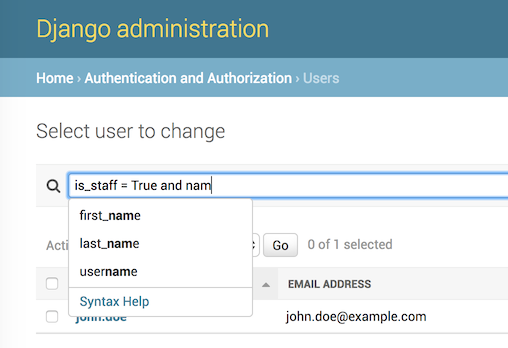
Advanced search language for Django, with auto-completion. Supports logical operators, parenthesis, table joins, and works with any Django model. Tested on Python 2.7, 3.6–3.13, Django 1.8–5.1. The auto-completion feature has been tested in Chrome, Firefox, Safari, IE9+.
Bug reports, bug fixes, and new features are always welcome. Please raise issues on the django-watson github repository, and submit pull requests for any new code.
You can run the test suite yourself from within a virtual environment with the following commands.
A transparent layer for full-text search using Sphinx and Django
This project is no longer maintained
This is a layer that functions much like the Django ORM does except it works on top of the Sphinx (http://www.sphinxsearch.com) full-text search engine.
Please Note: You will need to create your own sphinx indexes and install sphinx on your server to use this app.
There will no longer be release packages available. Please use SVN to checkout the latest trunk version, as it should always be stable and current.
Installation
To install the latest stable version:
sudo easy_install django-sphinx
To install the latest development version (updated quite often):
git clone git://github.com/dcramer/django-sphinx.git
cd django-sphinx
sudo python setup.py install
Note: You will need to install the sphinxapi.py package into your Python Path or use one of the included versions. To use the included version, you must specify the following in your settings.py file:
Provides a set of tools for managing Search Engine Optimisation (SEO) for Django sites.
================
Django SEO tools
================

This is a set of SEO tools for Django.
It allows you to associate metadata with:

* absolute paths
* model instances
* model classes
* views

Metadata can be edited in the admin in a centralised place, but also alongside any associated models.

This is however a framework, not an app. You therefore have
complete control over the data you store.
Here is an example of a definition::

    from rollyourown import seo

    class BasicMetadata(seo.Metadata):
        title          = seo.Tag(max_length=68, head=True)
        keywords       = seo.KeywordTag()
        description    = seo.MetaTag(max_length=155)
        heading        = seo.Tag(name="h1")
        subheading     = seo.Tag(name="h2")
        extra          = seo.Raw(head=True)

        # Adding some fields for facebook (opengraph)
        og_title       = seo.MetaTag(name="og:title", populate_from="title", verbose_name="facebook title")
        og_description = seo.MetaTag(name="og:description", populate_from="description", verbose_name='facebook description')

As you can see it is very flexible, but there is much more than this simple example.

The full documentation can be read online at http://django-seo.readthedocs.org/.
Simple wrapper around elasticsearch-py to index/search a django Model.
django_elasticsearch is a wrapper around py-elasticsearch that automates the indexation and search of django models. Note: if your elasticsearch documents/mappings are not close to django models, this package is probably not for you.
As stated in the python elasticsearch module documentation:
There are two branches for development - master and 0.4. Master branch is used to track all the changes for Elasticsearch 1.0 and beyond whereas 0.4 tracks Elasticsearch 0.90.
Releases with major version 1 (1.X.Y) are to be used with Elasticsearch 1.* and later, 0.4 releases are meant to work with Elasticsearch 0.90.*.
django_elasticsearch has only been tested with Elasticsearch 1.3.9 and it's corresponding python interface version 1.2.0, but since the API hasn't change i'm quite positive that newer…
Since version 0.5, the HaystackSearchApphook is not registered automatically anymore. If you want do use the default app hook provided by django-cms-search, add this (e.g. in models.py):
from cms_search.cms_app import HaystackSearchApphook
apphook_pool.register(HaystackSearchApphook)
If present, it is supposed to be a list/tuple of django apps for Jenkins to run Tests, reports, and coverage are generated only for the apps from this list.
JENKINS_TASKS
List of Jenkins reporters executed by ./manage.py jenkins command.
Default value:
JENKINS_TASKS = ()
JENKINS_TEST_RUNNER
The name of the class to use for starting the test suite for jenkins command Class…
django-nose provides all the goodness of nose in your Django tests, like:
Testing just your apps by default, not all the standard ones that happen to be in INSTALLED_APPS
Running the tests in one or more specific modules (or apps, or classes, or folders, or just running a specific test)
Obviating the need to import all your tests into tests/__init__.py This not only saves busy-work but also eliminates the possibility of accidentally shadowing test classes.
Useful additions to Django's default TestCase from REVSYS
Rationale
Let's face it, writing tests isn't always fun. Part of the reason for that is all of the boilerplate you end up writing. django-test-plus is an attempt to cut down on some of that when writing Django tests. We guarantee it will increase the time before you get carpal tunnel by at least 3 weeks!
If you would like to get started testing your Django apps or improve how your team is testing we offer TestStart to help your team dramatically improve your productivity.
This app aims to provide a simple way of loading masses of randomly generated test data into your development database. You can use a management command to load test data through command line.
It is named autofixture because it is based on django's fixtures. Without autofixture you add test data through the admin to see how the non-static pages on your site look. You export data by using dumpdata to send it to your colleagues or to preserve it before you make a manage.py reset app and so on. As your site grows in complexity the process of adding and re-adding data becomes more and more annoying.



































































































-green.svg)